
Africa Just Quietly Changed What It Teaches Its Children
Between September 2024 and September 2025, four African governments rewrote what their schools teach. The world barely noticed. Here is what it actually means for the next decade.

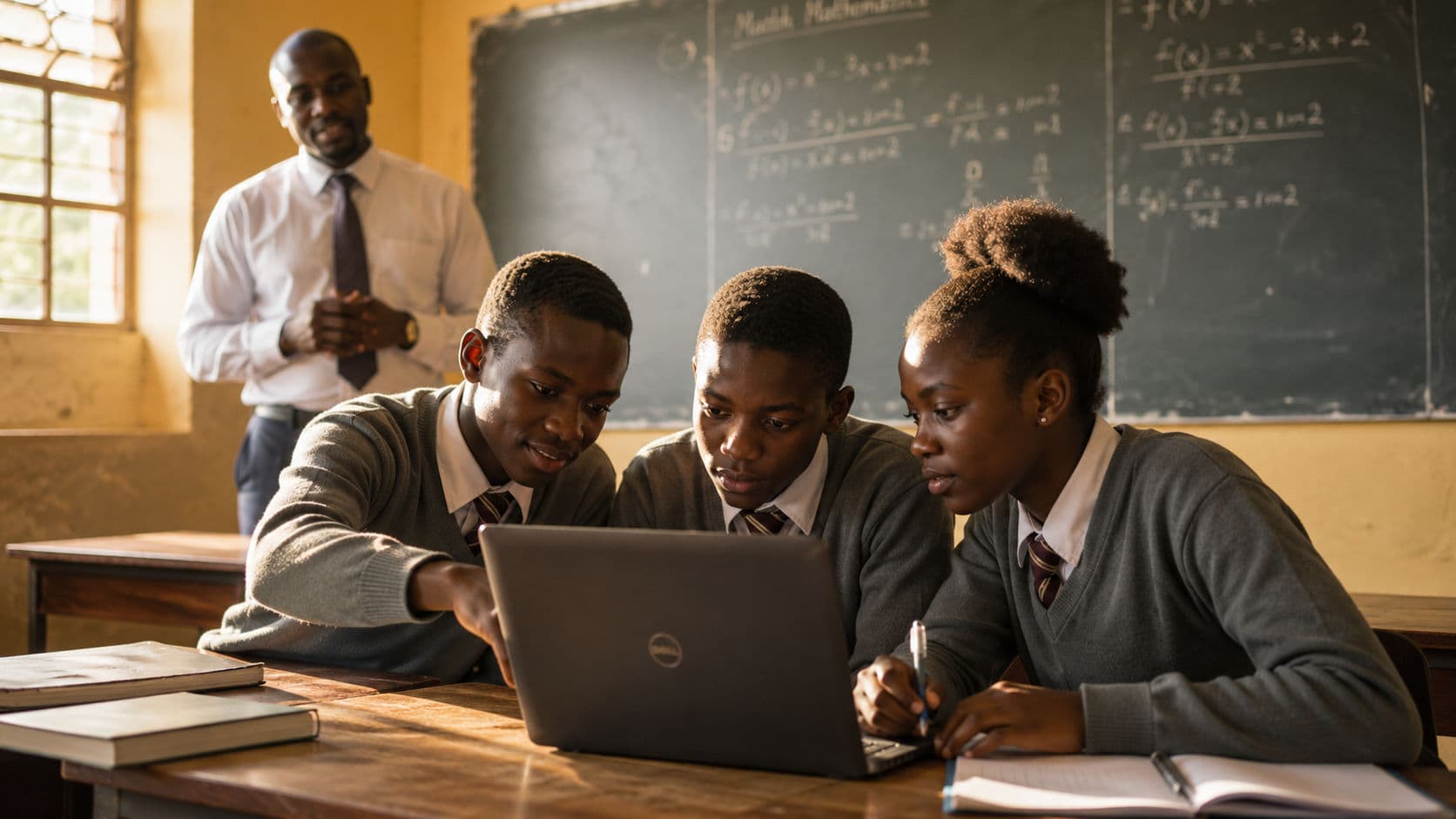
In a classroom in Kano, an eleven-year-old is being shown how to write her first line of computer code. Her teacher learned to code on a free online course three months ago. The textbook in front of her is a stapled photocopy. Outside, the generator is running. Inside, she is writing her first instruction for a machine.
Somewhere in Nairobi, the same scene. Somewhere in Cape Town, the same scene. Somewhere in Accra, the same scene.
Between September 2024 and September 2025, four African governments — Nigeria, Kenya, Ghana, South Africa — rewrote what their schools teach. They moved in close sequence. The biggest curriculum shift in the continent's history happened in eighteen months, with almost no global press coverage.
Here is what it actually means.
What changed, plainly
In September 2025, Nigeria's Federal Ministry of Education completed the largest curriculum overhaul in a generation. Every junior secondary student in the country is now required to study computer programming, basic robotics, and digital entrepreneurship — alongside English, maths and Nigerian History. Senior secondary students now have a formal Technology and Innovation track covering programming, artificial intelligence, cybersecurity, data science and robotics. The reform reaches roughly forty-eight million schoolchildren.
Kenya went further. In 2022, it became the first African country to put computer code on its national curriculum. In 2025, it published the Kenya National AI Strategy 2025–2030, formally placing artificial intelligence inside primary, secondary and higher education. A separate bill currently in parliament — the Computer Science for All Bill — proposes a single standardised computing curriculum from Grade 4 to Grade 12.
Ghana, quieter, more methodical. The country's curriculum council published a Computing syllabus for both junior and senior high schools, and a dedicated Robotics curriculum for senior students in April 2025.
South Africa moved slowest on policy, but in June 2024 it added coding and robotics to the national curriculum for grades R to 9 — and then quietly did something far more practical, which we will come to.
Four governments. Four moves. Eighteen months. One pattern.
The honest gap
None of these governments can yet deliver what they have written into law.
In Kenya, the public-school system is short of nearly one hundred thousand teachers. Sixty-five percent of Kenyan schools have no internet. A gigabyte of mobile data costs about ninety-nine shillings (less than a dollar) — a real number for a real parent. In Nigeria, many public schools still run on intermittent power and have no qualified computing teacher. In South Africa, the Department of Basic Education has openly said its priority is "back to basics" — literacy and numeracy first, before coding. The policy is ahead of the people. Not because the policy is wrong. Because building a school system takes longer than passing a law.
This is where the story gets unexpectedly hopeful.
The money is moving — and not from where you might think
While the world's attention has been elsewhere, a layer of African capital has quietly begun to fund the execution gap that governments cannot close alone. Real money. Real numbers. Worth knowing.
In February 2025, Moniepoint — the Nigerian fintech that has reshaped how money moves across this country — committed three billion naira (about two million dollars) to build three Innovation Hubs at Nigeria's biggest universities. Software, artificial intelligence, robotics, design, product-building, entrepreneurship. Open to students of every discipline. Their CEO Tosin Eniolorunda put it in one line: "Nigeria's digital future depends on homegrown, industry-ready talent trained within Nigerian universities." He put the money where the line was.
In October 2025, Safaricom — Kenya's largest company — announced what may be the largest single private-sector education investment in modern African history: thirty billion Kenyan shillings, roughly two hundred and thirty million dollars, to digitally upgrade six hundred Kenyan schools and provide ten thousand scholarships over five years. They called it Citizens of the Future.
In South Africa, the story is even quieter — and more advanced. Naspers Labs, the training arm of Africa's most valuable media company, has trained over seven thousand two hundred young South Africans in digital skills since 2022. More than six thousand two hundred of them are now in employment. Sixty percent of them are women. That is the most striking number in any of this research, and the most underreported.
Behind these African moves, the global tech giants have arrived. Microsoft has committed to training one million South Africans and one million Nigerians in artificial intelligence by 2026. Google has put three billion naira (also about two million dollars) into retraining Nigerian university lecturers — not students, lecturers — because they understood the actual gap better than most. The German government has funded a single digital-learning platform that is now deployed across all fifty of South Africa's technical and vocational colleges.
None of this is philanthropy. It is strategy. The companies that train the next generation of African workers on their tools will be the companies those workers spend the next forty years inside.
The lesson is simple. African governments wrote the law. African corporates and foreign tech giants are quietly funding the schools that have to deliver it.
What happens next
Three things will happen on top of this foundation in the next two to five years. None of them are dystopian. All of them are interesting.
First — artificial intelligence tutors will arrive in African classrooms at scale. A South African company called FoondaMate already runs an AI tutor inside WhatsApp for more than three million African students. It is free, text-only, and most parents who use it have no idea what it actually is. The next generation will speak — real voice conversations, in Nigerian English, in Swahili, in Twi — at a cost of around two thousand naira a month (about one and a half dollars), less than a single hour with a private lesson teacher in Lagos. This is the shift that will redefine which children get genuine, personal teaching — regardless of where they live or how much their parents earn.
Second — schools themselves will quietly become small media businesses. A school's best mathematics teacher, recorded once, can teach ten thousand students. A school's twenty-year alumni network is an asset that has never been used. The schools that notice this will turn five hundred enrolled students into five thousand paying learners across the continent — without adding a single new building.
Third — and this is the honest tension worth naming — the educators who teach on these platforms will face their own quiet pressure. The next wave of African content creators will not just compete with each other. They will compete with artificial intelligence that delivers the same explanation better, in any language, at a fraction of the cost. The teachers and creators who thrive will be the ones who offer what no machine can: mentorship, lived experience, regional context, the cultural translation of a global skill. Not a small surviving class — but a different one.
What this means for the African child
The child who turns sixteen in 2030 will be the first generation in this continent's history to graduate from school with curriculum-mandated computer literacy, working code, and basic familiarity with artificial intelligence. They will be more globally relevant at sixteen than most of their parents were at thirty. They will compete for remote work against peers in Manila and Mumbai — and not necessarily lose.
That is what just happened. Quietly. In eighteen months. Across four countries. While almost no one was watching.
The only question now is whether the platforms that make this real are built here, by us — or imported from elsewhere with our names slapped on them. Someone is going to build them. The only question is whether it comes from inside Africa — or from someone outside with a laptop and a very clear idea.